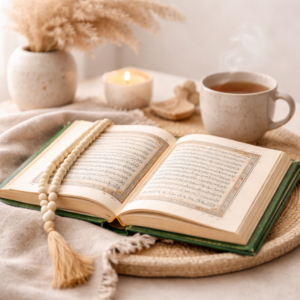
I used to think exhaustion was proof of devotion. That the more I gave, the more worthy I was. But over time, Allah revealed something more merciful: “Your body has a right over you.” (Bukhari)
Islamic self-care is not about luxury. It is not indulgence. It is — at its core — an act of worship. A way to honor the body, the soul, and the life Allah entrusted you with.
In this guide, my sweet sister, I’ll walk you through a heart-centered daily self-care routine — one that’s rooted in Islam, love, and intentional living. This is not just a list of tips. It’s a gentle conversation between us — woman to woman, Muslimah to Muslimah — from a place of sincerity, softness, and shared faith.
You deserve a space that feeds your spirit and strengthens your imaan. You deserve rituals that feel like healing, not hustle. You deserve reminders that you are worthy of love — starting with your own.
Let this guide be your soft return to yourself — rooted in faith, filled with presence, and aligned with who you truly are. You deserve to feel held, nourished, and seen — not just once, but every day.
1. Morning Niyyah for Muslim Women: Begin with Purpose
Before your feet touch the floor, whisper: “Alhamdulillah, who gave us life after death, and to Him is the return.” (Bukhari)
This isn’t just a morning routine. It’s a soul reset — a sacred moment between you and your Creator where you decide how to live today. With each intention, you draw closer to Allah.
Set your niyyah (intention). Whether you’re caring for children, working, or resting, choose to do it for the sake of Allah. Even brushing your teeth, when done with intention, becomes a form of worship.
Let your niyyah be the compass of your day. Practicing Islamic self-care for Muslim women starts right here — in the heart of intention.
2. Wudhu and Skincare: Islamic Self-Care Rituals for Muslim Women
Wudhu isn’t just purification for prayer — at least, not in how I experience it personally. While its primary purpose is to prepare us for Salah, I find that it can also become a moment of inner stillness and peace. This is a personal reflection, not a religious teaching — just one Muslimah’s way of feeling more present and grateful through something already beautiful in our deen.
After Wudhu, try applying a drop of rosewater or halal moisturizer. If you’re not sure where to start, you might find these gentle, summer-friendly skincare ideas helpful: Halal Summer Skincare for Muslim Women.
Close your eyes. Breathe. Thank Allah for your body.
This is not vanity. This is shukr. Gratitude for the vessel you live in.
3. Sunnah Nutrition for Muslim Women: Self-Care Through Food
Begin with Bismillah. Eat with your right hand. Sit. Slow down.
Islam gives us the wisdom of moderation and intention in every bite. Include prophetic foods like:
- Dates for natural energy
- Honey for digestion and immune support
- Olives and olive oil for anti-inflammatory benefits
- Barley soups for gentle nourishment
If you’d like more ideas to make your meals nourishing and healing, check out this full guide: Food Habits That Heal.
Your body is not a battlefield. It’s a trust. Nourish it in love and balance. These small, conscious acts are part of daily Islamic self-care for Muslim women — deeply rooted in prophetic example and balance.
4. Movement and Dhikr: Islamic Wellness for Muslim Women
The Prophet ﷺ walked regularly, encouraged strength, and avoided stagnation.
Stretch your limbs. Take a peaceful walk. Breathe deeply. With every inhale say “Allah”, and every exhale, “Hu”. Let your breath become dhikr. Let your body remember.
This is not exercise for a six-pack. This is embodied ibadah. For Muslim women, Islamic self-care includes even the way we breathe and move — gently, intentionally, and with remembrance.
5. Journaling for Muslim Women: Emotional Self-Care with Intention
There is something healing about writing. About pouring your heart onto the page and leaving your worries with Allah.
Try these Islamic journaling prompts. And if you’d like a cup of something soothing beside you, sip on a healing tea from this guide: Herbal Teas for Digestion & Relaxation:
- What did Allah teach me today?
- What do I need to release to feel at peace?
- Which part of my day felt most sacred?
Journaling isn’t just therapy. It can be a space for reflection, gratitude, or making heartfelt du’a — not a religious act itself, but a gentle tool for emotional release and personal connection with Allah.
6. Halal Skincare for Muslim Women: Gentle, Faith-Aligned Beauty
Let your skincare routine be soft, minimal, and intentional. You can explore deeply healing oil-based care here: 7 Natural Oils That Healed My Acne & Scars and Affordable Glass Skin Routine (2025):
- Cleanse gently (no stripping)
- Tone with rosewater
- Moisturize with black seed oil or aloe
- Protect with halal sunscreen (especially in summer)
Skincare, when approached with gratitude and intention, can be a personal act of care — not a religious obligation, but a means of honoring the body Allah entrusted to you. Choose halal products. Touch your face with kindness. Smile in the mirror.
This is beauty with modesty. Radiance with ruh.
7. Sleep and Trust in Allah: Evening Self-Care for Muslim Women
Our Prophet ﷺ took midday naps (qailulah). He ended his nights with du’a and dhikr. Rest was not a weakness. It was trust in Allah.
Before bed:
- Make Wudhu
- Recite Surah Al-Mulk or Ayatul Kursi
- Reflect on what went well
- Say: “Ya Allah, I surrender my soul to You.”
And if you’re looking to end your nights with more presence, here’s a step-by-step ritual that might inspire you: Islamic Evening Routine for Muslim Women.
Let sleep be a gentle surrender — not sujood, but a moment to place your trust in Allah before you close your eyes. A falling into Divine safety.
Conclusion: You Deserve to Be Cared For
“You deserve rituals that feel like healing, not hustle.”
“This is not vanity. This is shukr.”
Self-care, in Islam, is not selfish — especially for Muslim women seeking to live in harmony with their deen. It is sacred.
When we care for ourselves with faith and softness, we become stronger for everyone else. We embody the mercy that Islam teaches, and we serve from a place of calm, not burnout.
You are worthy of gentleness.
You are loved beyond measure.
And you are never alone.
May your days be filled with rituals that restore your ruh.
May your soul feel nourished, not depleted.
“Ya Allah, help me care for this amanah with love, humility, and peace.”
AQ: Self-Care in Islam for Muslim Women
Q: Is self-care allowed in Islam?
Yes. Islam encourages self-care when done with balance and sincere intention. The Prophet ﷺ prioritized hygiene, rest, emotional well-being, and moderation.
Q: What are practical self-care tips for Muslim women?
Wake with niyyah. Perform Wudhu with presence. Eat Sunnah foods. Move your body with dhikr. Journal your heart. Use halal skincare. Sleep with du’a and trust in Allah.
Q: How do I make self-care part of my daily Islamic routine?
Blend it into your worship:
Wudhu becomes skincare.
Dhikr becomes breathwork.
Journaling becomes du’a.
Intentional living is Islamic living.